HOW TO CHOOSE THE PERFECT CLOTH DIAPERING SYSTEM!
Congratulations!!
Whether you are newly pregnant, or the parent of
a toddler (or two!), you have a lot of choices ahead of
you.
Just as you gathered information on pregnancy, birth and
infant care - so you will want your diapering choice to be an
informed one.
For some, the decision to go with cloth instead of single-use
("disposable") diapers is just one step closer
to a cleaner environment for you and the newest member of
our global family!
By the time your baby is toilet-trained you will have changed
about 6,000 diapers. Don't you agree such an important
part of your baby's life deserves very careful thought? Since
investing in cloth diapers can sometimes be a major financial
decision, it pays to become knowledgeable about the choices
available.
The average new parent chooses a brand of diapers for the
following three reasons: easily located, cheap price or their
best friend uses that particular brand. You owe it to your baby's
comfort, and your wallet, to read further.
In a simple question and answer format, the following
information will help you to examine your needs, desires and
lifestyle - to help you decide on the perfect diapering system
for your baby and you.
Imagine burying 6,000 dirty diapers in your own
backyard, or neighbourhood par. That's two and a half tonnes of
"disposable" waste created by just ONE
baby in a complete 2 1/2 year diapering period. Each individual
has a responsibility to help protect our environment, and each
one of us CAN make a difference!
SUGGESTION: For at least a two week period,
collect all your used "disposable" diapers in a
green garbage bag in a corner of your kitchen - don't throw any
of them out! Sure, they will take up a lot of space, and will
probably stink - think about it!!!
(If you are still pregnant, ask a friend with a baby in
"disposable" diapers to try this for you. Ask her what
she thinks after two weeks.)
Most parents don't realize just how much they spend on
"disposable" diapers, as the cost usually gets
buried in the weekly grocery bill. By only purchasing one package
at a time, parents often don't stop to add up the dollars spent
each month.
Single-use ("disposable") diapers ARE
expensive. You can expect to change your new baby's diapers up to
320 times in just the first month alone! At a cost
of anywhere from 18-33 cents per single-use diaper, you'll
have spent $57.60 to $105.60! To diaper your baby
in single-use diapers for 2 1/2 years will cost you $1,559.00
+ $109.13 GST, for a total cost of $1,668.13!!!
Depending on the cloth diapering system you choose, it
wouldn't take long to recoup your initial investment. Simple flat
squares and quality brand waterproof pull-on pants would begin
paying their own way in less than TWO MONTHS. Even if you
opt for the top-of-the-line fitted diapers and Cot'nwrap
covers, they would begin to pay their own way in less than a
year.
That means your second and third years of diapering are FREE!!!
SUGGESTION: Choose three of your favourite
diapering options, and cost them out - diapers, night liners and
covers.
Inexpensive flat or prefolded diapers, fasten by Di-D-Klips,
Snappy Diaper Dastener or diaper pins, covered with Babykin nylon
pants, can be had for less than $130.00. Or, using these
diapers inside Velcro® or snap-closing covers, such
as Cot'nwrap, Bummis or Babykins wraps offer you
all the convenience and advantages of a fitted or an all-in-one
diaper - at a much more economical price.
SUGGESTION: Ask for the more expensive diapers
and covers for shower, baby Christmas and birthday gifts.
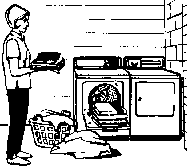
Parents no longer need to wash diapers. We have machines to do
it for us.
Try this routine: Toss two dozen diapers into
your washing machine, setting it to PreSoak/Superwash with Cold
Wash/Rinse. Take your baby to your change area and change baby's
diaper. Prepare yourself a cup of tea, and something to snack on.
Return to your washing machine, and set it to Regular Wash with
Hot Wash/Cold Rinse. As the machine fills, toss in 1/2 to 1 cup
of non-phosphate, gentle detergent (NOT Tide® with Bleach!)
and, if your diapers are stained, non-chlorinated bleach.
Go relax in your favourite chair, put your feet up, enjoying
your favourite radio or TV program or book, while baby nurses off
to sleep. Lay baby down in a safe place, toss the clean diapers
into your dryer, and enjoy the peace and quiet. When baby wakes
up, you'll have fluffy, clean diapers ready to use!
Now, did that take any longer than bundling up baby, trekking
out to the mall, hauling home huge bags of "disposable"
diapers with baby in tow, and then lugging the dirty diapers out
to the curb on trash day!?
SUGGESTION: If you breast-feed and use cloth
diapers, you will save more than enough to treat yourself to a
new washer and dryer!
Diaper services provide you with clean diapers on a weekly
basis. Their diapers are bacteria-free, subjected to extremely
hot temperatures and bacteria-killing rinses. The cost is at
least two times that of washing your own diapers - but your time
is precious in those early weeks. Spend your time recovering,
establishing a good milk supply and enjoying your new baby . . .
without adding to our growing landfill and environmental
problems.
SUGGESTION: If you choose to stay with the
diaper service - you'll only need to buy one dozen diapers for
emergencies and some waterproof covers.
All-in-One diapers are used exactly as a single-use diaper.
The only differences are they fasten with Velcro® or
snaps instead of tabs, and you toss them into a diaper pail
instead of a garbage pail.
SUGGESTION: Babykins All-in-One diapers
or Bummis and Chinese prefolds offer all the ease of
"disposables", at a very affordable price.
All-in-one diapers tend not to be breathable, so if your baby
needs frequent airing due to diaper rash . . . you may be better
off with a two-part diapering system.
SUGGESTION: If you prefer to purchase all-in-one
diapers, get an additional dozen without covers - to use when
baby's bottom gets rashy. Cot'nwraps 100% cotton covers
are totally breathable, so are an excellent way to reduce diaper
rash. If diaper rash is caused by urine contact, and frequent
changes don't seem to help, trying wiping a layer of Baby
Unpetrolium® Jelly on your baby's bottom at each diaper
change.
Attached waterproof covers tend to result in a less thorough
cleaning through the layers, since dirt and bacteria can become
trapped. Further, this type of diaper tends to take longer to
dry, since the dryer heat can only pass through one side of the
diaper.
SUGGESTION: Babykins All-in-One diapers
have the diaper part only partially attached, which greatly
improves cleaning and drying. Try using a Velcro® wrap
such as Bummis and flat or prefolded diapers. Once the
diaper is folded and placed in this type of cover, it goes on as
easily as an all-in-one - yet comes apart for easy cleaning and
quick drying.
Owning your own full-size machines makes laundering your cloth
diapers simple! If you plan to wash every day or so, you'll only
need to buy 1 to 2 dozen diapers. If, however, you must take your
diapers to a common laundry-room or laundromat - you'll probably
want to go longer between wash days. So you will need about 3 to
4 dozen.
SUGGESTION: If you have no access to laundry
facilities, a diaper service might be your best option - clean,
soft cotton diapers delivered right to your doorstep. Still
cheaper than using "disposable" diapers!
If your diapers take longer to dry than 60 minutes -
this will add up in extra expense. If you decide to wash every
day, remember that several small loads cost more than waiting
till you have a full load.
SUGGESTION: Wait to wash until you have 20-24
dirty diapers. Flat diapers dry in just 30-40 minutes. Or,
machine-dry your diapers for just 10-15 minutes, then hang
to finish drying. Hang up your covers to dry. They usually will
still dry with an hour or so.
Some parents find folding diapers very therapeutic . . . or
they do it while watching TV. But if you have several other
children, a very busy lifestyle or work outside the home - you
may not have time, or want to fold diapers.
SUGGESTION: Prefolded and shaped diapers require
very little folding. Just store diapers in a laundry basket as
they come out of the dryer. Or try fitted and all-in-one diapers,
which require no folding at all.
Velcro® and snap-closing diapers or covers eliminate
the need for pins. Di-D-Klips or a Snappy Diaper Fastener eliminate
pins too. Pins can be managed by most parents, but if you are
wanting a speedy, easy fit - try a pinless system. There IS
a certain skill required for neat and quick pinning.
SUGGESTIONS: Cot'nwrap, Bummis, Babykins,
Gerber EZ-Cover, etc. or Di-D-Klips and Snappy Diaper Fastener
eliminate the need of pins.
Some one-size diapers fit the average baby, but SOME DON'T!
Buying one-size diapers can save money over sized diapers, IF
THEY FIT. If the babies in your (or your partner's)
family tend to be large (i.e. 25+lbs at one year) you'll
probably find yourself needing to buy a second set of larger
diapers - if you've chosen shaped, fitted or all-in- one diapers.
SUGGESTION: Use flats or prefolds, babies tend
not to outgrow these. Use night liners inside Velcro®
covers for your newborn instead of a size small diaper, then
purchase only the size large diapers. Re-use the night liners
when baby wettings get heavier. Or buy the largest fitted diaper,
by the crotch depth and waist measurements.
Some diapers have their elastic so tight around baby's legs,
it leaves red marks. The elastic should hold softly while
preventing messy leaks.
SUGGESTION: Flats, prefolds and shaped diapers
have no elastic to bind your baby's tender skin. Babykins
fitted diapers have high-cut legs, avoiding this problem. Angel
tie-wraps and Babysnibbs have no elastic, so are perfect
for chubby legs.
Look for a diaper with over 300 grams of absorbency -
with a terrycloth or polyrayon core, or an all-terry diaper. Or
use Terry Diaper Doublers!
SUGGESTION: Try out our Snug-to-Fit
(formally Snap-to-Fit)or Cotton Kids
diapers. These are the most absorbent diapers we could find!
Double diaper with our thick and thirsty Terry Doublers -
made of 3 layers of 16 ounce terrycloth! This method
should last even the heaviest wetter through the night! Make sure
your covers have a good, snug fit around your baby's legs to
prevent leakage.
The elastic should be heat and chlorine-safe, to stand up to
the rugged washing diapers must undergo. Chlorine and the heat of
the diaper deteriorate regular elastics (as well as Velcro®
and vinyl). The elastic should be completely enclosed, so it
doesn't pinch or bind your baby's tender skin.
SUGGESTION: Use flat or prefolded diapers inside
a Velcro® or snap-closing cover. Since the elastic and
Velcro® are only on the cover it tends not to need to
be washed as frequently as your diapers. This means the covers
are subjected to less heat and wear during laundering.
Velcro® offers an infinite range of adjustments, and
makes diapering fast and easy enough for even Daddy to try.
Middle-of-the-night changes are a breeze. Velcro® needs
to be protected for laundering and drying - to keep them from
hooking and tangling one another. If you use bleach and
machine-dry, Velcro® tends not to hold as securely after
time. Velcro® with loose edges, that are easily grabbed,
is often undone by baby . . . very much to the distress of their
parents! Some diapers do not provide long enough Velcro®
for a secure hold. Watch for sharp corners or rough edges, which
may irritate your baby's skin.
SUGGESTION: Babykins diapers fasten in
back, which helps to prevent toddlers from unfastening them.
Bummis and Industrial Wraps are harder for toddler
fingers to grasp.
Snaps tend to provide a more secure fit, but have a slightly
less adjustment range than Velcro®. Two snaps per side
holds more securely, and offers a better fit. If snaps are not
securely fastened, they may fall off during laundering. Metal
snaps that touch baby's skin may irritate it.
SUGGESTION: Snug-to-Fit (formally Snap-to-Fit)
diapers have a unique system of snaps to make it a
one-size-fits-all diaper. Litewraps and Snapiwraps
come with both Velcro® and snaps, for a more secure fit.
Diapers and covers that fasten with ties are easily adjusted
to fit, and offer the widest variety of sizes. Cotton ties tend
to get wet along with the diaper, which causes them to tighten.
This can make them difficult to untie. Polyester ties don't soak
up wetness, or tighten. They are stronger, and last longer.
Cotton ties tend to tangle in the wash, polyester doesn't.
SUGGESTION: Try our
Angel nylon Tie-wraps.
Cotton fillers absorb moisture quicker, and wick it away from
your baby's skin to evaporate, leaving baby's skin cooler and
drier. Every time you introduce a synthetic material you raise
the temperature inside the diaper slightly, and increase the risk
of an allergic reaction. Synthetic pads or fiberfill can trap
dirt and bacteria, so are often harder to keep clean. Inner
paddings of 100% rayon are said to go rock-hard after several
washings. Loose fiberfill tends to shift and lump up.
SUGGESTION: Diapers with a low rayon count, with
a breathable cover such as Cot'nwrap.
Every row of stitching will add to the drying time, and making
it harder to clean out the dirt and bacteria. Leakage can occur
at any stitching point appearing on the outside of an all-in-one
or diaper cover.
SUGGESTION: Babykins All-in-One diapers
have an open-flap system for quick-drying. Bummis and
Industrial Wraps have little outside stitching, so are
less likely to leak.
Like any clothing, diapers need to be designed properly to fit
well. It needs to prevent messy leaks, without being overly
bulky. If the diaper is to narrow at the crotch, it will leak. If
it's too wide, the fabric will bunch up and make your baby
uncomfortable. If diapers are cut too high at the sides and gaps
at the front, you will need to overly-tighten it at the waist to
make the diaper fit properly at baby's legs.
The waist should adjust to fit your baby - too wide, it will
fall off a newborn. Too small, it won't fit around a chubby
belly. The crotch depth should be deep enough to last till
training, yet adjust small enough that your newborn won't be
lost!
SUGGESTION: For a newborn or small baby, start
out with the smallest diaper cover, using night liners inside.
These are big enough to cover a newborn's bottom . . . and can be
used until your baby fits into the larger size diaper. Then use
the liners again inside your baby's diaper for extra absorbency!
Diapers with a frill should be Safety-Lock serged, to
provide greater durability. Otherwise it may unravel. Make sure
all of the frill on the diaper is tucked inside the cover to
prevent leaks. Some feel there is better protection against
leakage when the elastic is sewn right to the edge. However, you
should check that the edges are bound in soft trim, with no harsh
edges or exposed elastic to pinch or irritate your baby's
delicate skin. Also it should be bound in a non-absorbent
material, or it will wick moisture out to baby's clothing.
The most absorbent diaper will not necessarily meet all your
needs. It might require buying several sizes, be a poor fit for
your baby, not offer the convenience you are looking for (i.e.
an all-in-one, breathable like Cot'nwrap).
It may have a synthetic padding, when you demand all-cotton. It
may fasten with Velcro®, when you wanted snaps, ties or
clips. It may take longer to dry, leak at the legs, or be poorly
constructed. You must also take your finances into consideration.
PLUS, babies should be changed every two to three hours
anyway (even when in "disposables"!). Unless
your baby is a heavy wetter, you may have bought more diaper than
you need, while losing the features that are more important to you.
SUGGESTION: Choose the diapering system that
fits all your needs and budget best, and add extra liners for
night-time or heavy-wetters.
Ask for this kind of diaper as gifts. Use Velcro® or
snap-closing covers, with a less expensive diaper inside. Buy a
pattern and the fabric of your choice, and make your own!
Almost any diaper will fit well with any liner or cover. Find
the diapers, covers and liners that meet both your baby's and
your needs best.
SUGGESTION:Try something like this: Fitted
diapers for every-day use. Flats for emergencies, and
folded up inside your fitted diapers for double-diapering
at night. Use Babykins pull-on pants for regular use,
Cot'nwraps if baby gets a diaper rash, Cotton
Bummis for dress-up or summer shorts. And maybe some
Angel Tie-Wraps in your diaper bag for emergencies. Think
up your own combinations, to fit YOUR lifestyle and budget!
Waterproof covers are a necessary complement to cloth diapers.
These covers come in the following styles: pull-ons, tie-ons, Velcro®
and snap-closing. Covers come in a wide variety of materials:
wool, waterproof 100% cotton, acrylic, polyester, plastic, vinyl
and nylon. Prices range from 3/$1.59 for cheap plastic pull-ons
to $40.00 for all-wool Nikkys.
SUGGESTIONS: Hand-knit your own Down Under
soakers to save money!
PLASTIC - Cheap plastic pull-ons are not a smart
investment. They harden and crack with repeated launderings, and
the elastic at the waist and legs tends to irritate baby's skin.
Because plastic doesn't allow moisture to evaporate, it can
contribute to diaper rash. It is worthwhile spending a few
dollars more for good waterproof pull-ons that will last.
SUGGESTION: Babykins vinyl or nylon
pull-ons, Whisper nylon pull-ons.
PINLESS COVERS - Waterproof pants not only
prevent messy leaks, but can also (depending on how snugly it
fits) hold the diaper in place without pins. If you want to
avoid using pins, consider Velcro®, snap or tie-on diaper covers.
SUGGESTION: Angel Tie-Wraps are an economical
nylon tie-pant. Unlined Babykins Velcro® wraps are also a
good choice.
BREATHABLE COVERS - There are many
types of diaper covers that come in 100%
wool, polyester, fleece or cotton, are 100% breathable and
water-resistant. They are an excellent choice to help prevent
diaper rash - and they eliminate the need of pins at the same
time. The disadvantages are if baby is left wet for more than one
to two hours, or is a heavy-wetter - these covers do tend to
leak. Plus,some brands are VERY
expensive.
SUGGESTION: Double diaper or use extra liners.
Use breathable covers during the day, when you are able to change
baby more frequently and Babykins nylon pull-ons for
night-time protection. Or, try some of the more reasonable
alternative brands such as Cot'nwrap (100% cotton and
breathable), Litewrap ( 100% polyester and
breathable) or Bummis nylon wraps (100%
nylon and somewhat breathable).
As you can see...
there is more involved in making a decision about diapering
than just choosing the brand your best friend is using. Diapering
affects your baby's health and safety, your lifestyle and budget.
And everyone's environment!
We recommend that you review the facts about each diapering
option, before you decide. Once you have chosen, you can feel
confident you have made an informed decision on the perfect
diaper for your baby and you.
Happy diapering!
|