
|
|||||
|---|---|---|---|---|---|

|
|||||
|
|
|||||
|---|---|---|---|---|---|
|
|
|||||


 Popular Articles: |
by Suzanne Elston, reprinted with permission
|
When Joy Towles Cummings moved back to her family's farm in Taylor County, Florida in 1981, one of the first things she noticed was how polluted the water in the Fenholloway River had become since she left the community in 1965.
Her teenage son, Trev, urged his mother to do something about it. Mom, that's the nastiest thing,
he said. You need to make them clean it up.
Touched by her son's faith in her maternal abilities to set things straight, Joy began investigating.
What she discovered was that the river was being polluted by effluent from Proctor and Gamble's Buckeye pulp mill, which produces pulp for
such products as Pampers® and Luvs® disposable
diapers, Attends® incontinence pads, and Always sanitary napkins.
Despite the fact the river water was dark brown, Joy was shocked to discover that the company wasn't violating any state laws. In 1947, local residents and Proctor and Gamble officials had convinced the state legislature that classifying the Fenholloway an industrial
river
would bring jobs into the area. Under that classification, the plant has the right to deposit sewage, industrial and chemical
wastes and effluents, or any of them, into the water of the Fenholloway River and the Gulf of Mexico.
As Towles Cummings explains, The only restriction on the company is that they are not allowed to dump anything that interferes with the
navigation of the river.
For Joy, enough was enough. A kind of funny thing happens in your head when you realize that your community has been sacrificed so that a
company can make huge profits,
she says in her soft, southern drawl.
Getting Proctor and Gamble to clean up the river proved to be a much tougher task than Joy could have imagined. When she spoke out in her
community, the local media labelled her an ...armed, radical, environmental terrorist.
Local business leaders in support of
Proctor and Gamble dubbed her group, Help Our Polluted Environment (HOPE), a pseudo-environmental cult
, in a letter to state environmental regulators.
Joy laughs when she describes herself in her attacker's words. She believes that what makes her so threatening to company officials is that she is a well-respected member of the community, not a radical extremist.
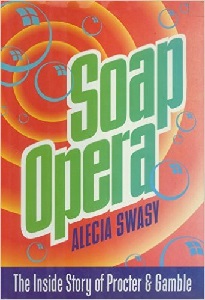
Soap Opera : The Inside Story of Procter and Gamble |
All we asked for is clean water. My God, that isn't so outrageous, is it?
says Towles Cummings.
Joy's fears about the quality of the river water were substantiated by a 1990 Environmental Protection Agency study that showed the Fenholloway had dioxin levels 1,900 times higher than what the agency considers an acceptable risk. Local residents were advised not to drink the water, and in 1991 Proctor and Gamble began distributing bottled water in the community, rather than clean up their mess.
Debate over what Proctor and Gamble is doing to the river has split the community. People who were best friends since they were born are no longer speaking to each other,
says Joy. Tensions came to a head in April 1992, when Stephanie McGuire, a colleague of Joy's, was
brutally beaten and raped by three men who told her to stop battling Proctor and Gamble.
For McGuire, the attack was enough to make her leave the community. As Joy explains, She will probably never recover from the emotional
scars.
For Towles Cummings, however, the work is only beginning. She is currently one of over 200 local residents suing Proctor and Gamble to make the company pay for its damages.
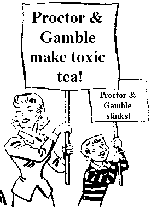
Last fall, Joy spoke at a rally outside Proctor and Gamble's Toronto office. Clutching a bottle of dark brown toxic tea
taken from the Fenholloway River, she called upon demonstrators to boycott Pampers® and Luvs® disposable
diapers, Attends® incontinence pads, and Always® sanitary napkins.
As Joy explained, the degradation of her community is a direct result of our consumer lifestyles. We need to understand that my community is suffering from one kind of pollution in order to provide communities across North America with disposable products that create a
different kind of environmental problem in everybody's community.
AUTHOR'S NOTE: Despite numerous attempts, officials at the Proctor and Gamble plant in Florida refused to comment on this issue.
FOR MORE INFORMATION:
WEED Foundation, 517 College St, Suite 233, Toronto, Ontario M6G 4A2 ~ Phone: 416-928-0880 ~ Fax: 416-928-9640 ~ Email: we.mag@utoronto.ca
This article compliments of Born to Love.
Send questions, comments, and suggestions to: catherine@borntolove.com
Born to Love articles are written by Catherine McDiarmid-Watt
Born to Love is a participant in the Amazon Services LLC Associates Program, an affiliate advertising program designed to provide a means for sites to earn advertising fees.
NOTE: All logos, company names, brands, images, trademarks and other intellectual property are the property of their respective owners.
Born to Love is a participant in the eBay Partner Network, an affiliate advertising program designed to provide a means for sites to earn advertising fees by advertising and linking to eBay.com.
Copyright © 1978 - BorntoLove.com - All Rights Reserved.
Last updated - April 5, 2024


